Dell Latitude 5450 review: what this guide can verify
A sensible Dell Latitude 5450 purchase decision starts with a distinction that is easy to overlook: Dell’s public site shows a broad laptop and business-computing ecosystem, plus support entry points, but the supplied material does not verify the specifications of a particular Latitude 5450 configuration. That matters because a product name alone is not enough to establish fitted memory, storage layout, battery design, ports, weight, warranty entitlement, or replaceable parts.
Dell’s public pages identify Dell Pro laptops, Dell laptops and business-laptop categories, while its support surfaces point customers towards drivers, downloads, warranty and contract information, parts, batteries and upgrades. Those are useful starting points for research, not a substitute for model-specific documentation. Before comparing a Latitude 5450 listing with alternatives, identify the exact configuration and country of sale, then locate the official product and support material attached to that machine.
This approach is deliberately documentation-first. It helps buyers separate what Dell publicly offers across its range from what is actually confirmed for the individual laptop they may buy, inherit, repair or upgrade.
Strengths: Dell’s support and update ecosystem
For an owner, Dell’s support structure is the strongest confirmed part of the available evidence. Dell’s support product pages expose routes for drivers and downloads, support resources, manuals and documents, articles, videos and service events. Dell’s main public site also links customers to support, drivers and downloads, warranty and contract information, and parts, batteries and upgrades.
In practical terms, that gives an owner a sensible first route when something needs attention. Start by identifying the product, then use the official support area to look for the documentation and downloads associated with it. Manuals can help establish maintenance procedures; driver and download pages can help locate available software and firmware; warranty and contract pages can help clarify the service context. The support surface itself says that its resources cover installation, maintenance and troubleshooting information.
There is an important qualification. Some Dell resources may require a company account or additional access permissions. A generic support page can therefore show that a support path exists without proving that every document, part record or service action is publicly available to every visitor. Regional storefronts, business accounts and the exact device identity may also affect what appears.
That does not make the support ecosystem less useful. It makes it more important to verify the specific machine before treating an upgrade or repair as straightforward.
Strengths: a documented approach to firmware and software currency
Dell also publishes structured update-catalog information for PowerEdge servers. Its documentation describes PowerEdge catalogues as collections of bundle and Dell Update Package metadata used by Dell management tools to list current software and firmware versions for relevant servers and devices. Dell says the server catalogues are refreshed weekly, and describes catalogues containing BIOS, firmware, drivers and certain applications.
This is useful context for Dell’s documented approach to organising update metadata and distributing current-version information. It supports a cautious expectation that official Dell update channels, rather than random download sites, should be the first place to check when maintaining Dell equipment.
However, it is server documentation, not Latitude 5450 documentation. It does not confirm which BIOS, firmware, drivers, applications or components are available for a Latitude 5450. It also does not establish compatibility, installation order or update eligibility for a particular client laptop. Treat it as evidence of a structured Dell update practice in a different product area, then return to the exact laptop’s official support page for the decision that affects you.
Limitations: model-specific repairability still needs confirmation
The supplied evidence does not confirm the Latitude 5450’s memory slots, memory type or maximum capacity. It does not confirm its storage bays, SSD interface, battery design, keyboard or display replacement process, port selection, weight, service-part availability, or exact regional specifications. It therefore cannot support a claim that this model is upgradeable, especially repairable, light, well connected or easy to service.
This gap is commercially important. Two listings carrying the same family name can differ by processor, memory, storage, operating system, warranty package and market. An apparent bargain may have a configuration that does not match the parts, service option or lifecycle you expect. Likewise, a generic Dell page that lists parts, batteries and upgrades is evidence that Dell provides those support categories; it is not evidence that a particular Latitude 5450 component is available, user-replaceable or covered.
Access can be another limit. Dell notes that some support resources are permission-controlled and may require a company account. Documentation may also vary by country or be tied to a recognised product identity. For that reason, do not order a battery, SSD or memory module on the assumption that the family name confirms compatibility. Verify the exact configuration and the applicable official documentation first.
Practical guidance for buyers and current owners
AI-generated generic editorial illustration — not a retailer product photo and does not depict the reviewed product or service. Make the support-and-update verification path immediately usable for prospective buyers and current owners.
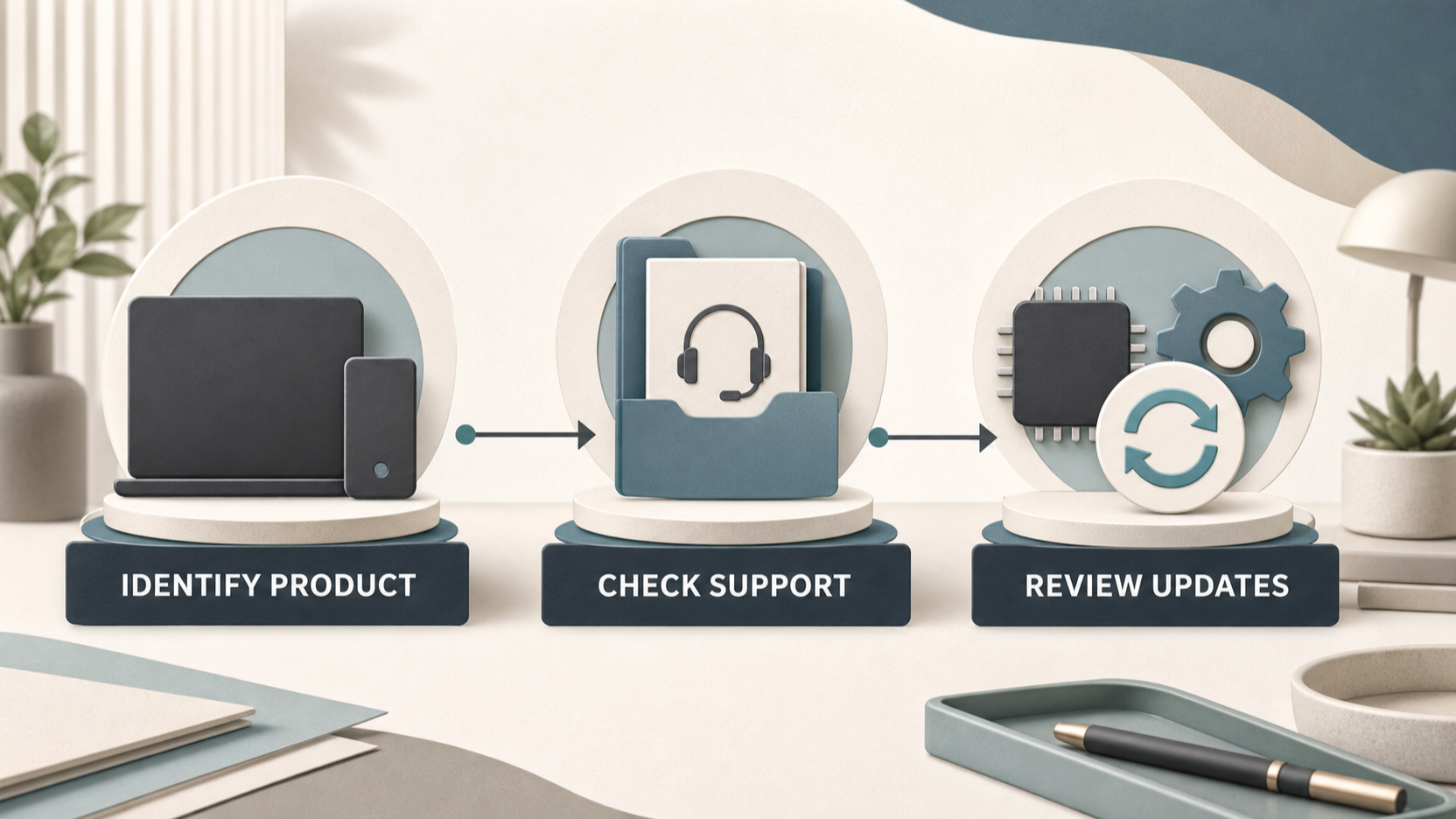 Use a four-step check before buying, upgrading, repairing or replacing a Latitude 5450.
First, identify the exact machine. Ask the seller for the full configuration and, where appropriate, the service tag or equivalent product identity. Record the country of sale, operating system, installed memory and storage, warranty status, condition and any known faults. A configuration label is more useful than a broad product-family description.
Second, use Dell’s official support routes. Look for the relevant drivers and downloads, manuals and documents, support articles, warranty information and any parts or battery information available for that exact device. If you cannot access a relevant resource, treat that as an unresolved check rather than filling the gap from a third-party listing.
Third, confirm the decision-critical details. For an upgrade, confirm the supported part type and service procedure before purchasing anything. For a repair, confirm whether the suspected component is documented, available and economically sensible to replace. For a purchase, compare the delivered configuration and support entitlement against the price, not simply against other laptops with a similar name.
Finally, compare repair cost with remaining value. A home-office user may prioritise dependable support access and a configuration that already meets daily needs. A small business may place more weight on repeatable documentation, warranty terms and planned lifecycle management. An existing owner should include diagnosis time, parts cost, service availability and the risk of downtime when comparing repair with replacement.
The outcome should be a documented decision: buy when the configuration and support position meet your needs; upgrade only when compatibility and procedure are confirmed; repair when the cost and remaining usefulness justify it; replace when the unresolved risk, downtime or total cost becomes disproportionate.
Who this Dell business-laptop approach suits
This documentation-first Dell approach suits home-office users who want to reduce surprises before spending on a used or refurbished work laptop. It is also a good fit for small-business buyers who need a repeatable way to compare configurations, support options and lifecycle costs across more than one device.
It is particularly helpful for owners deciding between a repair and a replacement. Rather than assuming a component is accessible or compatible, they can use Dell’s support routes to establish what is documented for the exact machine, then make a cost-based decision. This is more useful than a universal claim about repairability because it respects differences in configuration, regional availability and service entitlement.
It may be less convenient for buyers seeking a quick, specification-only verdict. The available evidence supports careful verification, not a definitive performance or upgradeability ranking for the Latitude 5450. For those who value predictable ownership, however, that caution is a practical advantage.
Frequently Asked Questions
Where can I find official Dell support material for a Latitude 5450?
Start with Dell’s official support area and identify the exact product. Dell’s support pages provide routes to drivers and downloads, manuals and documents, articles, videos and support resources. Dell’s public site also links to warranty and contract information and to parts, batteries and upgrades. Availability can depend on the product identity, region and, for some resources, account permissions.
Does the available evidence confirm that the Latitude 5450 memory or storage is upgradeable?
No. The supplied evidence does not confirm memory slots, supported memory, storage bays, interfaces or upgrade procedures for the Latitude 5450. Check the official documentation for the exact configuration before buying memory or storage hardware.
How should I check whether a battery or other part is serviceable before buying it?
Identify the precise laptop first, then check Dell’s official support and documentation routes for relevant manuals, parts information and warranty or service terms. Confirm compatibility, availability and the applicable procedure before ordering. A general Dell link to batteries or upgrades does not prove that a particular part is available or user-serviceable for this model.
When is repairing a business laptop more sensible than replacing it?
Repair is generally more sensible when the fault is understood, the compatible part and service route are confirmed, the cost is proportionate to the laptop’s remaining usefulness, and downtime is acceptable. Replacement becomes more compelling when support details remain unresolved, repair cost rises close to the value of a suitable replacement, or the current configuration no longer meets work requirements.
Explore official Dell support resources
Sources
Related reading
- Best repairable business laptops for German buyers: evidence-led top choices
- Lenovo ThinkPad T14 Gen 5 review: serviceability, configuration choices, and buyer fit
- HP EliteBook 840 G11 review: configurations, upgrade paths, and business fit
- How to choose a repairable laptop: parts access, documentation, and upgrade checks
Editorial information: About our editorial team · Read our editorial policy · Read our affiliate disclosure.